Marina Lyubimova

The contrast is significant. According to the chart, Mastercard’s dividend-per-share measure increased from $0.06 in Q1 2011 to $3.27 by Q1 2026, while shares outstanding moved consistently in the opposite direction.
At the same time, Mastercard’s share count fell from approximately 1.31 billion to 883 million. That represents a reduction of about 427 million shares, or 33% of the starting share count.
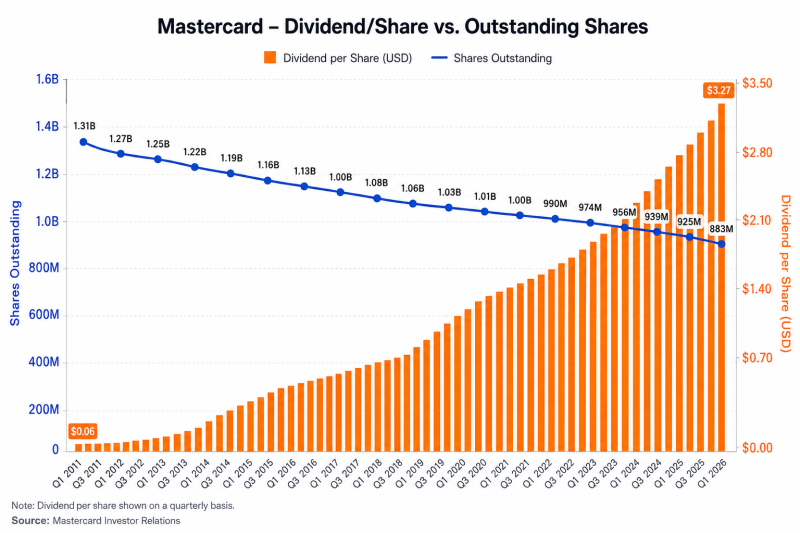
The decline in shares outstanding has been remarkably persistent:
- 2011: ~1.31 billion shares
- 2015: ~1.16 billion
- 2018: ~1.06 billion
- 2020: ~1.01 billion
- 2021: below 1 billion
- 2024: ~925 million
- 2026: ~883 million
The combination matters because buybacks and dividend growth reinforce each other. With fewer shares outstanding, Mastercard can distribute more cash per remaining share without requiring total dividend spending to increase at the same pace.
The shrinking denominator also provides a structural lift to earnings per share. If net income were unchanged, reducing the share count from 1.31 billion to 883 million alone would increase EPS by roughly 48%.
The dividend trend has accelerated as well. The chart shows a particularly strong increase in the per-share distribution measure during the latter part of the period, while the share count continued to contract.
Taken together, the numbers show that Mastercard has not relied on a single method of returning capital. Over roughly 15 years, it has simultaneously increased cash distributions to shareholders and retired about one-third of its equity base.
 Marina Lyubimova