Marina Lyubimova

The dollar index fell about 0.3%, while the U.S. 10-year Treasury yield eased toward 4.70%. That combination matters for USD/JPY because the pair remains highly sensitive to the gap between U.S. and Japanese yields.
USD/JPY — Recent Move
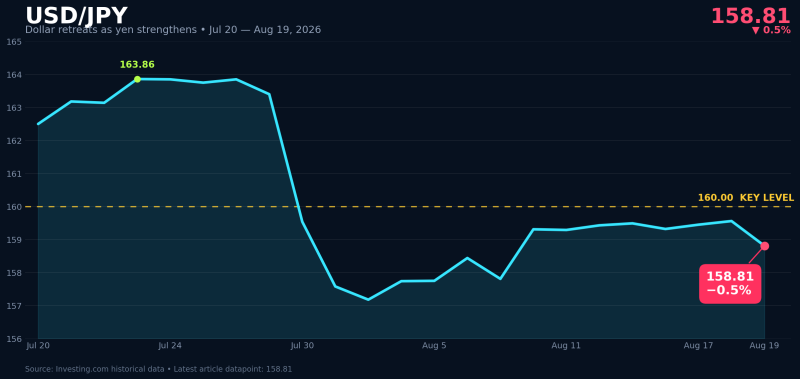
USD/JPY approached 164 in late July before falling sharply. At 158.81, the pair is now roughly 3% below that peak, but remains high enough to keep Japanese currency policy in focus.
Why 160 Matters
The 160 area has become more than a technical level. Japanese and U.S. authorities intervened in late July after the yen weakened to around 163.99 per dollar, near its weakest level in roughly four decades. USD/JPY subsequently fell toward 157 before recovering.
The rebound has stalled below 160.
| USD/JPY | Market signal |
| Above 160 | Yen pressure returns; intervention risk rises |
| 158–160 | Current policy-sensitive range |
| Below 158 | Yen recovery gains momentum |
| Below 155 | Larger reversal of the dollar rally |
The proximity of 160 changes the risk-reward for traders. Further dollar gains could bring intervention concerns back quickly, while a break below 158 would put more recent dollar-long positions under pressure.
U.S. Rates Are Driving the Move
The immediate catalyst is increasingly coming from the U.S. rather than Japan. Expectations for another Federal Reserve rate increase have weakened following softer U.S. economic data. The probability assigned to a September hike fell to about 30.6% on August 17 from 52.2% a week earlier.
That shift directly affects USD/JPY. Higher U.S. yields increase the return available from holding dollars relative to yen. When expectations for Fed tightening decline, that advantage narrows.
Lower Fed expectations → lower Treasury yields → smaller U.S.-Japan rate gap → less support for USD/JPY.
The U.S. 10-year yield is therefore one of the clearest indicators to watch alongside the exchange rate. Continued yield declines would make a sustained move below 158 more plausible.
Carry Trades Can Amplify Yen Gains
The rate differential also supports a large pool of yen-funded carry trades. Investors can borrow at relatively low Japanese rates and deploy the funds into higher-yielding currencies and assets. A weak or stable yen improves the economics of those positions; rapid yen appreciation does the opposite.
When USD/JPY falls quickly, leveraged investors may have to reduce exposure and buy yen to close funding positions.
Yen rises → carry returns fall → leverage is reduced → investors buy back yen.
That feedback loop means FX volatility can spread into equities, bonds and other leveraged positions. The risk becomes larger when the initial currency move coincides with falling U.S. yields.
The BOJ Adds a Second Pressure Point
Japan provides the other side of the rate equation. Any increase in expectations for tighter Bank of Japan policy would raise Japanese yields while weaker U.S. rate expectations pull Treasury yields lower. Both developments would compress the yield differential that has supported USD/JPY.
That creates a more difficult setup for dollar bulls than intervention risk alone. The yen would no longer depend primarily on direct currency intervention for support; monetary-policy convergence could begin doing part of the work.
Levels That Matter Now
158 is the immediate downside level. A sustained break would extend the yen recovery and increase pressure on dollar-long positions.
160 remains the key upside threshold. A return above it would revive concerns about renewed yen depreciation and possible official action.
Below that, 155 would represent a much larger change in the market structure. At 158.81, USD/JPY is still within the broad range established after the late-July reversal. The important change is the macro backdrop: U.S. rate expectations are falling while the pair is already trading close to a politically sensitive level.
If Treasury yields continue lower, 160 may shift from a temporary ceiling into resistance.
 Marina Lyubimova