Marina Lyubimova
The payment followed the September 2024 ruling by the Court of Justice of the European Union, which upheld the European Commission’s finding that Ireland had granted Apple unlawful state aid through preferential tax treatment.
The dispute centered on approximately €13 billion in back taxes. Apple had already transferred €14.3 billion, including interest, into an escrow account in 2018 while appealing the case.
Apple’s Tax Bill in Numbers
| Metric | Amount |
| Taxes paid to Ireland | ~$17bn |
| Apple global corporate income taxes paid | ~$43bn |
| Ireland’s share | ~40% |
| Original EU back-tax assessment | €13bn |
| Amount transferred to escrow in 2018 | €14.3bn |
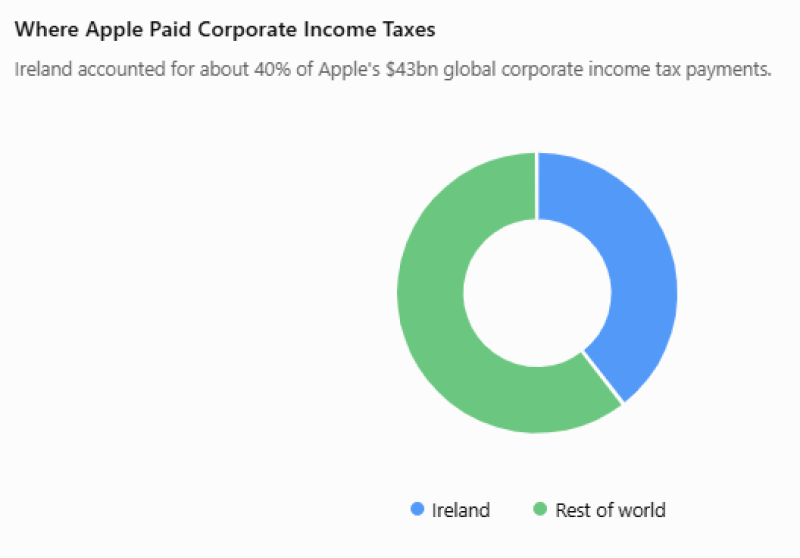
The Irish payment therefore represented roughly 40% of Apple's worldwide corporate income-tax payments for the period.
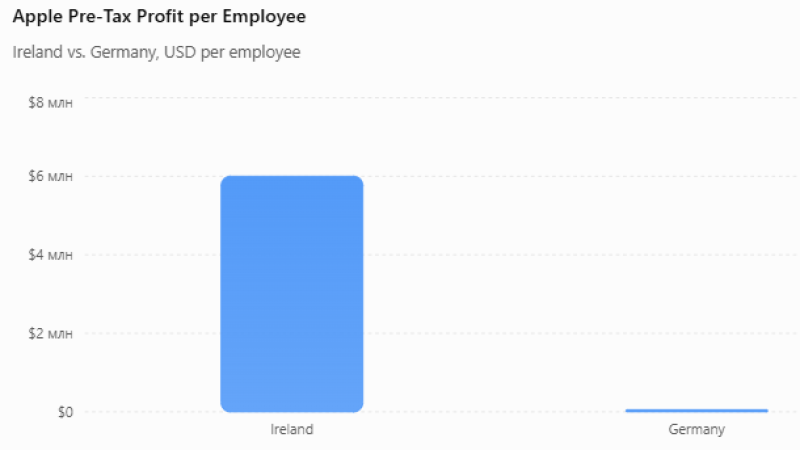
The settlement is largely a one-off event, but Apple's country-level disclosures show that Ireland remains important to its tax structure. About 25% of Apple's global pre-tax profit was booked through Irish entities, while only around 3% of its employees were located in the country.
Apple reported 5,575 employees in Ireland, implying approximately $6 million of pre-tax profit per employee.
Germany provides a useful comparison:
| Ireland | Germany | |
| Apple employees | 5,575 | 4,089 |
| Pre-tax profit per employee | ~$6m | ~$51,000 |
The gap reflects where Apple recognizes intellectual property, assets and profits within its international corporate structure rather than differences in employee productivity.
Ireland’s Dependence on Corporate Taxes Is Growing
Ireland collected almost €33 billion in corporation tax in 2025, an increase of 17.2% year over year. Corporation tax now accounts for roughly 30% of Irish tax revenue. The concentration is also high: Ireland's 10 largest corporate taxpayers generated 59% of corporation-tax receipts in 2024. That makes multinational tax revenue increasingly important to the country's public finances.
Apple’s Payment Is Mostly a Settlement, Not a New Tax Shock
The $17 billion figure does not represent an unexpected new liability for Apple. Most of the disputed money had been placed in escrow in 2018, meaning the final EU court decision primarily determined that the funds should go to Ireland.
The more important long-term figure is the 25% share of Apple's global pre-tax profit booked through Irish entities.
Ireland has moved from its historical 12.5% corporate tax model toward the 15% global minimum tax framework for large multinational companies, but it remains a major profit center for U.S. technology companies.
 Marina Lyubimova