Artem Voloskovets

- 1. AI Capex Is Becoming the Number to Watch
- 2. Capex vs. Free Cash Flow
- 3. AI Risk Is Now Index Risk
- 4. Earnings Expectations Matter More Than P/E
- 5. Bond Yields Could Force a Repricing
- 6. Revenue per Dollar of AI Infrastructure
- 7. The Dot-Com Comparison Has One Useful Lesson
- What Could Break the Trade
The concern is not whether AI will be commercially important. It is whether earnings can grow fast enough to justify AI-related valuations, capital spending and market concentration.
The internet transformed the economy after 2000, but that did not prevent technology stocks from collapsing when expectations outran profits. AI investors face the same distinction between technological adoption and investment returns.
1. AI Capex Is Becoming the Number to Watch
AI requires heavy spending on GPUs, servers, networking, data centers, cooling and electricity infrastructure.
The first phase benefited companies supplying that infrastructure. The next phase depends on whether companies buying it can generate sufficient revenue and cash flow.
A useful measure is:
Incremental AI revenue ÷ incremental AI capital expenditure
If spending continues rising much faster than AI-related revenue, expected returns on that investment deteriorate.
| Stage | What matters |
| Infrastructure buildout | Chips, servers and data-center spending |
| Capacity expansion | Cloud and computing capacity |
| Monetization | Revenue generated from AI products |
| ROI | Cash flow relative to accumulated investment |
| Consolidation | Capital shifts toward profitable applications |
The transition from capacity expansion to monetization is the critical stage.
2. Capex vs. Free Cash Flow
Revenue growth alone does not show whether AI investment is economically attractive.
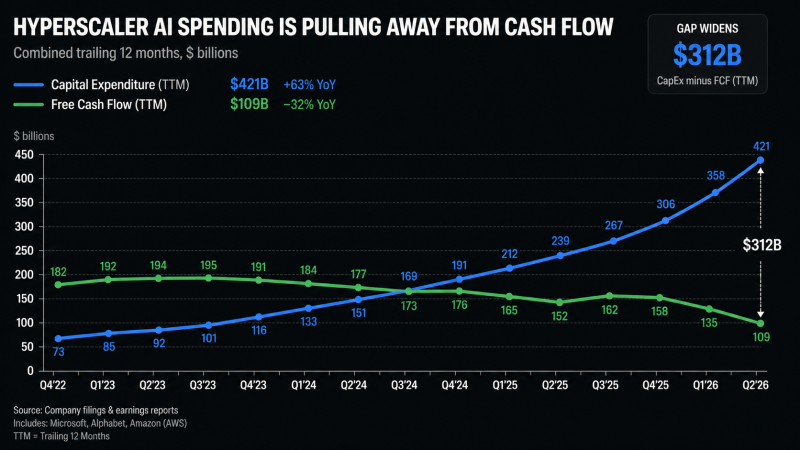
Large infrastructure spending can increase revenue while reducing free cash flow. The warning signal is:
Capex growth > operating cash-flow growth > declining free cash flow
Investors have rewarded companies for expanding AI capacity. That becomes harder to sustain if capital expenditure keeps accelerating without a comparable increase in cash generation.
3. AI Risk Is Now Index Risk
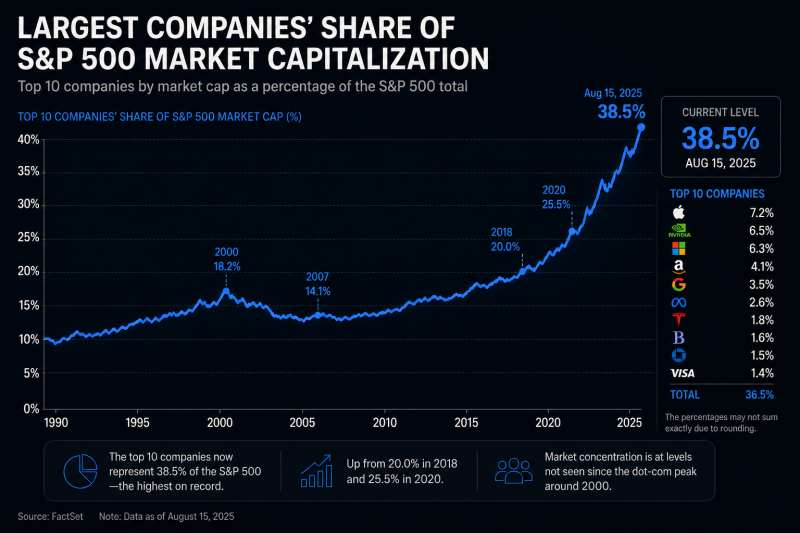
AI exposure is concentrated among some of the largest US companies. Because major indexes are weighted by market capitalization, a correction in a small group of mega-cap stocks can materially affect the entire market.
This creates a feedback mechanism:
AI expectations → higher mega-cap valuations → larger index weights → greater index dependence on AI
The mechanism also works in reverse. A broad recession is therefore not required for a substantial index correction. Falling valuations among the largest AI-related companies could be enough.
4. Earnings Expectations Matter More Than P/E
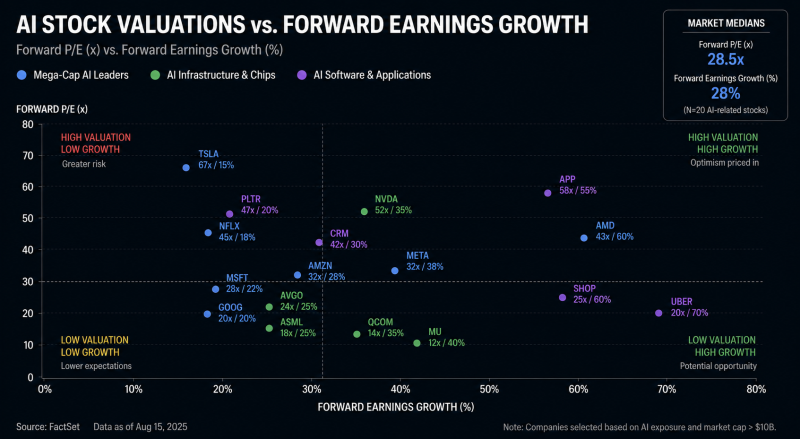
A high P/E ratio alone does not establish that a stock is in a bubble. Rapid earnings growth can justify a high multiple.
The dangerous combination is:
high valuation + slowing earnings growth + falling analyst estimates
| Forward P/E | Expected earnings growth | Valuation signal |
| 40× | 40% | Growth may support the multiple |
| 40× | 20% | Expectations become harder to meet |
| 40× | 10% | Significant valuation risk |
For AI stocks, earnings revisions may provide a better warning signal than headline P/E ratios.
5. Bond Yields Could Force a Repricing
Bank of America’s two largest tail risks are closely connected. An AI bubble was cited by 32% of respondents. A disorderly rise in bond yields was cited by 27%. Higher yields reduce the present value of future earnings, putting particular pressure on growth stocks.
For example, $100 received ten years from now is worth approximately:
| Discount rate | Present value |
| 4% | $68 |
| 6% | $56 |
| 8% | $46 |
The future cash flow is unchanged. Only the discount rate moves. A sharp rise in Treasury yields could therefore compress AI valuations even if company revenues continue growing.
6. Revenue per Dollar of AI Infrastructure
The key question is shifting from how much companies spend on AI to what they earn from that spending.
| AI investment | AI revenue | Signal |
| Rising | Rising faster | Improving monetization |
| Rising rapidly | Rising slowly | ROI deteriorating |
| Flat | Rising | Improving economics |
| Falling | Falling | Investment cycle weakening |
Utilization, pricing, margins and return on invested capital will become more important as the infrastructure buildout matures.
Persistent growth in AI spending without comparable revenue growth would be one of the clearest signs of overinvestment.

7. The Dot-Com Comparison Has One Useful Lesson
The internet was not a failed technology. Valuations failed.
Internet adoption, e-commerce, digital advertising and online software eventually exceeded many expectations from the late 1990s. Investors still suffered enormous losses because prices had moved ahead of earnings.
AI has several similarities:
| Dot-com cycle | AI cycle |
| Rapid internet adoption | Rapid AI adoption |
| Telecom infrastructure boom | Data-center/GPU boom |
| Heavy capacity investment | Heavy computing investment |
| High growth expectations | High AI revenue expectations |
| Uncertain eventual winners | AI winners still being determined |
There is one major difference: many companies funding today's AI expansion already generate large profits and cash flows. That reduces financing risk, but not valuation risk.
AI Bubble Dashboard
The strongest warning would be deterioration across several indicators at the same time.
| Indicator | Normal expansion | Bubble warning |
| AI capex | Tracks demand | Outruns monetization |
| AI revenue | Accelerates | Misses expectations |
| Free cash flow | Stable/rising | Falls as capex rises |
| Earnings estimates | Rising | Analysts cut forecasts |
| Market concentration | Stable | Increasing dependence on few stocks |
| Treasury yields | Stable | Rapid long-term yield increase |
| Infrastructure utilization | Rising | Excess capacity |
A single weak indicator is unlikely to end the AI trade. Several deteriorating simultaneously would be more significant.
What Could Break the Trade
AI does not need to fail for AI stocks to fall.
A more plausible sequence is:
Capex remains high → revenue growth slows → monetization takes longer than expected → earnings estimates fall → Treasury yields rise → valuation multiples contract.
Market concentration could amplify the decline because the largest AI-related companies carry significant weight in major US indexes. The critical variable is therefore not AI adoption itself but the gap between investment and returns.
Bank of America’s survey captures the shift in investor concerns: 32% see an AI bubble as the largest tail risk and 27% see a disorderly bond-yield surge as the second-largest.
The survey will quickly become dated. The underlying indicators will not.
AI capex, free cash flow, earnings revisions, infrastructure utilization, index concentration and bond yields will show whether profits are catching up with the expectations already embedded in AI valuations.
 Artem Voloskovets