Artem Voloskovets
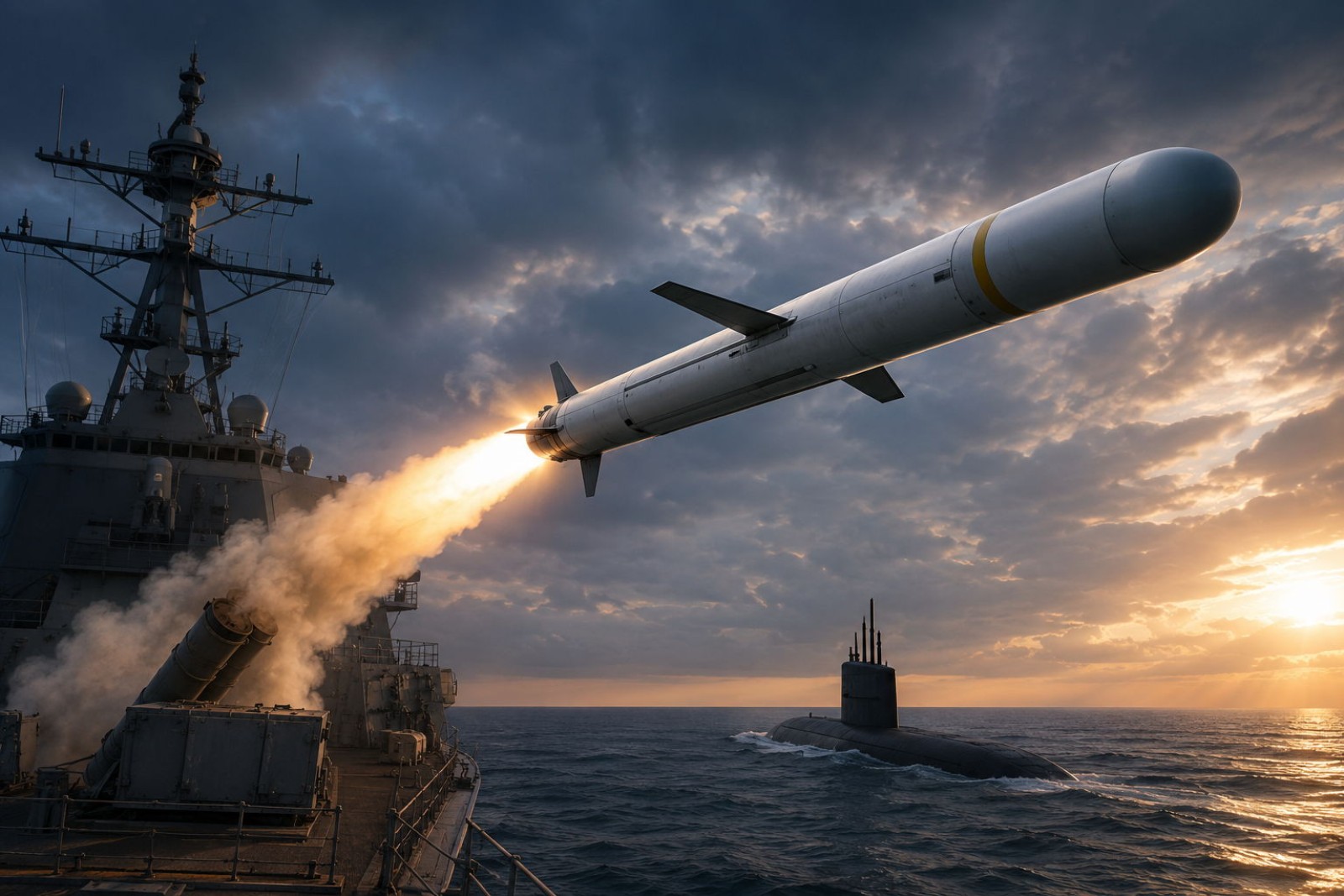
- Tomahawk production is moving from dozens to more than 1,000 missiles
- Deliveries have already tripled
- What the Tomahawk can do
- More than 2,300 operational launches
- Block V, Block Va and Block Vb
- Tomahawk production is one part of a larger Raytheon expansion
- How much does a Tomahawk cost?
- Why $22.9 billion is not immediate RTX revenue
- RTX is adding manufacturing capacity
- Why the Navy is using a seven-year contract
- How large is $22.9 billion for RTX?
- RTX entered the contract with a $119 billion defense backlog
- The numbers that matter after the contract announcement
Raytheon plans to increase Tomahawk production to more than 1,000 missiles per year. RTX also says it delivered three times as many Tomahawks in the first half of 2026 as in the same period of 2025.
The contract combines missile procurement with a longer-term effort to expand manufacturing capacity and the supplier base.
$22.9 billion Tomahawk contract: key numbers
| Contract ceiling | $22.9 billion |
| Duration | 7 years |
| Contractor | Raytheon / RTX |
| Customer | U.S. Navy |
| Production target | More than 1,000 missiles annually |
| Range | About 1,000 miles |
| Launch platforms | Surface ships and submarines |
| Operational use | 2,300+ launches |
| Flight tests | 550+ |
| Main Raytheon production site | Tucson, Arizona |
Tomahawk production is moving from dozens to more than 1,000 missiles
The production target is a major departure from recent procurement volumes. When Raytheon announced its missile-production agreements with the Pentagon in February 2026, the company outlined plans to expand Tomahawk output from roughly 60 missiles annually to more than 1,000.
That would represent more than a 16-fold increase in annual production capacity.
Recent Pentagon procurement quantities were much smaller:
| Fiscal year | Procurement quantity | Program funding |
| FY2023 | 68$ | 901.5 million |
| FY2024 | 34$ | 934.3 million |
| FY2025 | 22$ | 765.4 million |
| New annual production target | 1,000+ | — |
The funding figures include more than the purchase price of completed missiles, so they cannot be divided by procurement quantities to calculate unit cost. The difference between recent procurement volumes and the new 1,000-plus production target shows the scale of the planned manufacturing expansion.
Deliveries have already tripled
RTX says Tomahawk deliveries in the first half of 2026 were three times higher than in the first half of 2025. Raytheon is expanding production facilities in Tucson, Arizona, and the Tomahawk program relies on hundreds of small and medium-sized U.S. suppliers.
Increasing final assembly alone would not support a 1,000-missile annual rate. Production also depends on higher output of propulsion systems, guidance electronics, warheads, sensors, specialized materials and precision components.
The seven-year contract gives Raytheon and its suppliers a longer order horizon for adding equipment, employees and manufacturing capacity.
What the Tomahawk can do
Tomahawk is a long-range, subsonic cruise missile used for precision strikes.Its approximate range is 1,000 miles, allowing ships and submarines to attack targets without operating close to hostile territory.vUnlike ballistic missiles, Tomahawk remains inside the atmosphere and can fly at low altitude along programmed routes.
Current versions support capabilities including:
- in-flight retargeting;
- two-way communications;
- GPS-assisted navigation;
- resistance to GPS interference;
- low-altitude flight;
- precision strikes against fixed targets;
- attacks against moving maritime targets on selected variants.
Tomahawks are launched primarily from U.S. Navy surface ships and submarines.
More than 2,300 operational launches
Tomahawk entered U.S. service in the 1980s and has remained operational through successive upgrades rather than replacement by an entirely new missile. Raytheon reports more than 550 flight tests and over 2,300 operational uses. The missile has been repeatedly updated in navigation, communications, targeting and mission flexibility. That upgrade path eventually produced the Block V family now entering wider service.
Block V, Block Va and Block Vb
The current Tomahawk family includes versions optimized for different targets.
| Variant | Primary role | Main difference |
| Block V | Land attack | Updated navigation and communications |
| Block Va | Maritime Strike | Designed to attack moving ships |
| Block Vb | Hard-target attack | Enhanced warhead capability |
The Block Va Maritime Strike Tomahawk (MST) is particularly important for naval operations. Traditional Tomahawks were primarily associated with strikes against fixed land targets. Block Va adds a multimode seeker designed to locate and attack moving surface vessels.
That gives Navy ships and submarines another long-range anti-ship option without requiring an entirely new missile architecture. The production expansion covers both Land Attack and Maritime Strike Tomahawks.
Tomahawk production is one part of a larger Raytheon expansion
Raytheon is simultaneously increasing production across several major missile programs.
| Missile | Planned annual production |
| Tomahawk | 1,000+ |
| AMRAAM | 1,900+ |
| SM-6 | 500+ |
The company also has agreements covering SM-3 Block IB and SM-3 Block IIA interceptors.
The programs serve different missions:
- AMRAAM is primarily an air-to-air missile used by aircraft including the F-15, F-16 and F-35.
- SM-6 can perform air defense, missile defense and anti-surface missions.
- SM-3 is designed for ballistic-missile interception.
- Tomahawk provides long-range conventional strike capability.
The simultaneous expansion reduces the Pentagon’s dependence on small annual production lots across several high-demand missile categories.
How much does a Tomahawk cost?
There is no single unit price that can be reliably calculated from the $22.9 billion contract.
Pentagon program funding can include missiles as well as:
- support equipment;
- spare parts;
- engineering;
- modifications;
- testing;
- research and development;
- logistics and program support.
For example, FY2023 documents listed 68 Navy and Marine Corps Tomahawks and approximately $781.7 million in procurement funding, while total Tactical Tomahawk program funding including R&D was about $901.5 million.
Dividing $901.5 million by 68 would produce a misleading unit price because not all of that money paid for completed missiles. The same applies to the new contract.
Why $22.9 billion is not immediate RTX revenue
The $22.9 billion figure is a contract ceiling over seven years, not a single payment to RTX.
A simple division gives an average ceiling of:
$22.9 billion ÷ 7 = $3.27 billion per year
That number should not be interpreted as expected annual revenue. Actual sales depend on funded orders, production schedules, deliveries and other work performed under the contract.
Similarly, assuming 1,000 missiles annually for seven years and dividing $22.9 billion by 7,000 would produce about $3.27 million per missile, but that is not a valid estimate of Tomahawk's unit price. The contract covers more than missile hardware, and annual quantities can vary.
RTX is adding manufacturing capacity
Tomahawk production is centered at Raytheon facilities in Tucson, Arizona. RTX reported $2.6 billion of capital expenditures in 2025, including investment associated with expanding production of critical munitions. Raytheon has also completed a $115 million expansion in Alabama supporting SM-3 and SM-6 production. The manufacturing program therefore includes additional physical capacity rather than relying exclusively on higher utilization of existing lines.
Missile production has long lead times. Increasing output can require new machinery, factory space, skilled workers and additional capacity at component suppliers. Those investments are difficult to justify when manufacturers receive relatively small annual orders with limited visibility beyond the next budget cycle. A seven-year agreement gives manufacturers a longer demand horizon.
That makes it easier to:
- place larger orders with suppliers;
- purchase long-lead components earlier;
- expand factory capacity;
- hire and train workers;
- automate production;
- reduce production bottlenecks.
The production target therefore depends on both Raytheon's assembly lines and capacity throughout its supplier network.
How large is $22.9 billion for RTX?
RTX generated $24.7 billion in Q2 2026 sales. Raytheon, one of RTX's three major business segments, reported approximately $8.27 billion in quarterly sales, up 18% year over year. Raytheon operating profit was approximately $1.04 billion, up 29%.
For scale, the maximum Tomahawk contract value equals about:
- 93% of RTX's Q2 2026 companywide sales
and
- 2.8 times Raytheon's Q2 2026 sales.
Those comparisons show the size of the award but not its near-term financial contribution because revenue will be spread across multiple years.
RTX entered the contract with a $119 billion defense backlog
RTX reported a $289 billion total backlog at the end of Q2 2026.
That consisted of:
| Backlog | Q2 2026 |
| Commercial aerospace | $170 billion |
| Defense | $119 billion |
| Total | $289 billion |
Total backlog increased 22% year over year.
RTX's 2026 outlook following Q2 called for:
| Metric | 2026 outlook |
| Adjusted sales | $95.0–$96.0 billion |
| Organic sales growth | 8–9% |
| Adjusted EPS | $7.10–$7.25 |
| Free cash flow | $8.50–$8.75 billion |
The Tomahawk agreement adds a seven-year production program to an already large defense order book.
The numbers that matter after the contract announcement
The contract value alone will not show whether the production expansion is working. The measurable indicators are:
- Tomahawk output: Raytheon is targeting more than 1,000 missiles annually, compared with roughly 60 previously.
- Funded orders: The $22.9 billion ceiling only becomes economically relevant as the Navy places and funds orders.
- Raytheon backlog: New funded Tomahawk orders can increase visibility beyond the current $119 billion defense backlog.
- Capital spending: Higher production requires factory and supplier investment before all associated revenue is recognized.
- Margins: Larger production volumes could improve manufacturing efficiency, but expansion costs and supplier constraints can offset those gains.
- Block Va deliveries: Maritime Strike Tomahawk volumes will indicate how quickly the Navy is adding long-range anti-ship capability.
The difference between recent procurement quantities of 22–68 missiles per year and planned capacity exceeding 1,000 annually is the central figure in the new contract.
The $22.9 billion agreement gives Raytheon seven years of procurement visibility to build that capacity while the Navy increases inventories of both land-attack and maritime-strike Tomahawks.
 Artem Voloskovets